
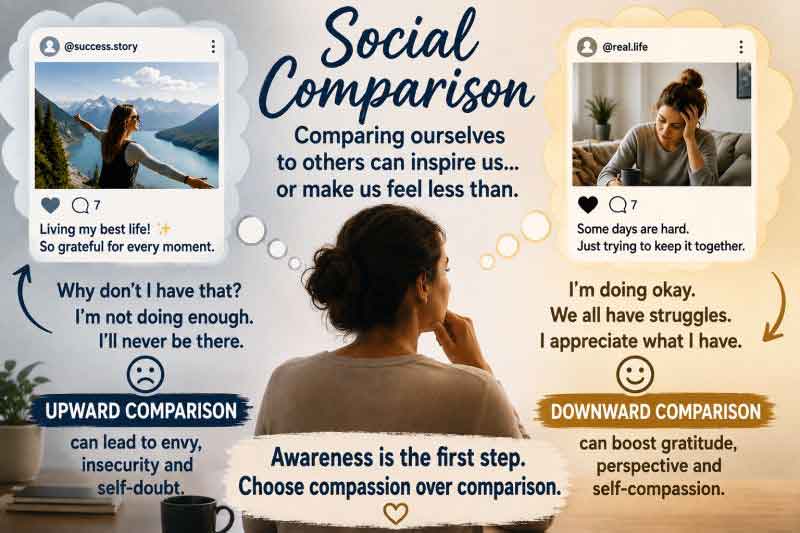
Social comparison is when we compare our abilities, accomplishments, relationships, appearance, or life situations to others. When it happens too often, it can affect our mood, how we feel about ourselves, and our overall happiness.
We may feel jealous, angry, invisible, or like we’re not good enough. We may think that we’re not moving forward fast enough in life.
There are two distinct types of social comparison:
1) Upward Comparison:
Comparing yourself to someone you think is doing better.
🟢 A colleague who got promoted.
🟢 A friend who lost weight.
🟢 A neighbor who remodeled their home.
2) Downward Comparison:
Comparing yourself to someone you think is doing worse:
🟢 A relative who does not look their best.
🟢 A coworker with problems at work.
🟢 An acquaintance with marital issues.
Social media has made it much easier for us to compare ourselves to others because people usually post only the best parts of their lives. The pictures are carefully chosen and likely make them look happy, smart, or well connected.
It’s always about their successes rather than their struggles. This creates the illusion that everyone else is happier, more attractive, more successful, or more connected than they actually are.
When Social Comparison Is Unhealthy
🟢 You see someone else’s success as your failure.
🟢 Your mood changes after scrolling social media.
🟢 You keep questioning if you’re “good enough.”
🟢 You focus on what you don’t have.
🟢 You struggle to be happy for others.
Strategies to Help Reduce Unhealthy Social Comparison
🟢 Only compare yourself to who you were.
🟢 Have gratitude for the good things in your life.
🟢 Reduce how much you use social media.
🟢 Be happy for others.
🟢 Know that someone else’s success doesn’t reduce yours.
🟢 Remember that people reach goals at different times.
Success is about what matters to you, not other people. Be kind to yourself and focus on your values. Instead of comparing, think about your own growth. Instead of wondering, “Why am I not where they are?” Ask, “What’s my next important step?”
Research shows that although social comparison is difficult to avoid, how we frame it makes all the difference. Instead of judging ourselves, we can use it as a tool to keep us motivated.